The Real Cost of Driving: Fixed vs Variable Expenses

Updated: Mar 10

Most people track what they spend at the pump—but that is only part of the story.
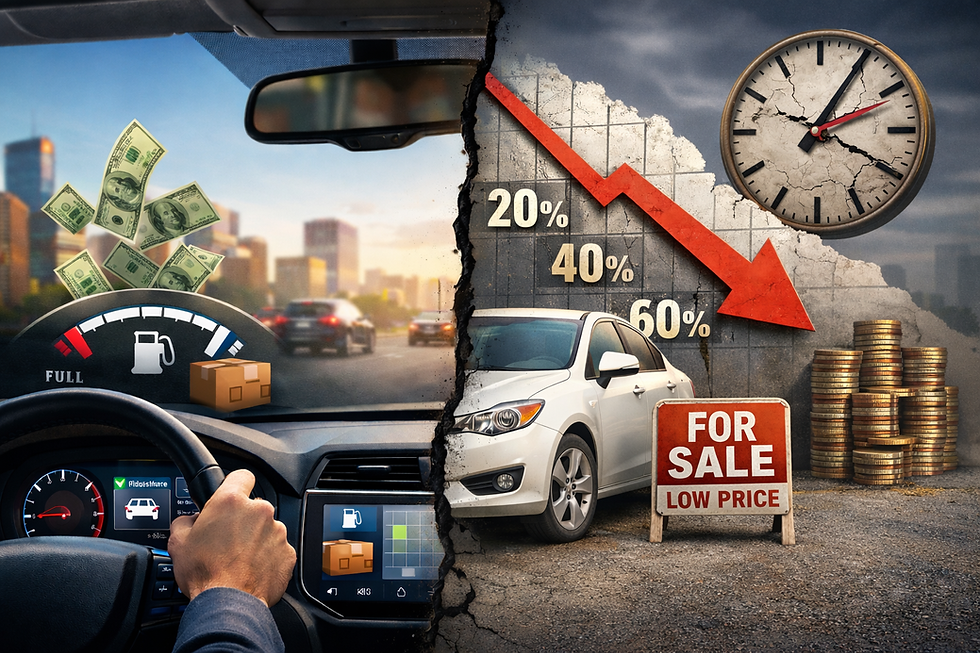
Fuel is visible. It is easy to notice, easy to remember, and easy to blame. But the real cost of driving includes more than what happens at the gas station. Some costs rise with every mile. Others keep showing up whether you drive or not.
If you only look at fuel, it is easy to mistake gross revenue for real progress.
Why this matters
When you work for yourself, revenue is loud and costs are quiet.
Money coming in gets your attention right away. Costs are different. Some happen in small pieces. Some are delayed. Some sit in the background on autopay. Some do not show up until something wears out and suddenly becomes urgent.
Those quieter costs are often what decide whether a week that looked good on the surface was actually good.
The two buckets: costs that move and costs that do not
A useful way to think about driving costs is to separate them into two groups.
Variable costs change when your miles and hours change.These include things like fuel, maintenance wear, tires, brakes, and other costs that build as you use the vehicle.
Fixed costs keep showing up even when you are not driving.These can include insurance, your phone plan, subscriptions, and a car payment if you have one.
The goal is not perfect accounting.
The goal is to stop treating fuel like it is the only cost that matters.
A simple example
Imagine two drivers who finish the week with the same gross revenue.
Driver A got there with fewer miles and fewer hours.
Driver B got there with more miles and more hours.
Even though their gross totals match, the week did not cost them the same.
Driver B likely used more fuel, created more wear, and gave up more time to produce the same result. That difference matters. Time has value, even when it never appears on a receipt.
That is why gross revenue alone is not enough to judge how the week actually went.
Where people usually go wrong
A lot of people make the same early mistake: they count gas, look at the total that came in, and call the rest profit.
But that leaves out too much.
It leaves out fixed costs that quietly continue in the background. It leaves out wear that builds slowly until it turns into a repair. It leaves out the longer-term cost of using a vehicle for work. And it leaves out the fact that two people can earn the same gross revenue at very different real cost.
When those pieces are missing, it becomes much harder to tell whether a week was truly strong or just looked strong at first glance.
How Drive Planner Pro helps
This is exactly where Drive Planner Pro becomes useful.
The free calculator helps you start with a clearer baseline by taking your totals and turning them into something more meaningful. Instead of looking only at gross revenue, you can start viewing the work in terms of per-hour and per-mile results, with built-in operating cost estimates to help you move beyond fuel alone.
That gives you a better starting point.
If you want a more complete view, the deeper calculator tools let you save your own expense profile so your results are measured against costs that reflect your actual situation—not just rough starting estimates. That includes core operating costs, recurring monthly expenses like phone bills and car payments, and even a depreciation model so your numbers reflect the broader cost of using your vehicle for work over time.
That does not make the math perfect. It makes it more honest.
And better decisions usually start when the numbers become more honest.
Better questions to ask
Instead of asking, “How much did I make?”
Try asking:
What did this work actually produce after accounting for the real cost of doing it?
Which of my costs rise when I drive more?
Which of my costs continue even when I do not drive?
What expenses am I most likely to ignore until they become urgent?
Those questions usually tell you more than gross revenue by itself ever will.
Reflection questions
If I drove 20% fewer miles, what costs would change—and what costs would not?
What are my fixed costs each week just to stay operational?
Which delayed cost surprises me most often: repairs, tires, insurance changes, or something else?
Am I evaluating my week by gross revenue, or by what the work likely cost me to produce?
Final thought
The real cost of driving is bigger than what you spend at the pump.
Fuel matters. But so do wear, fixed costs, delayed expenses, and the long-term cost of using your vehicle for work.
When you start seeing those pieces more clearly, a “good week” becomes easier to evaluate honestly. And once that baseline is clearer, it becomes much easier to make better decisions from there.
Home | Free Calculators | Blog | Sign Up
Disclaimer: This content is for general informational purposes only and is not tax, legal, or financial advice. Costs and results vary by vehicle, market, and individual circumstances.


Comments